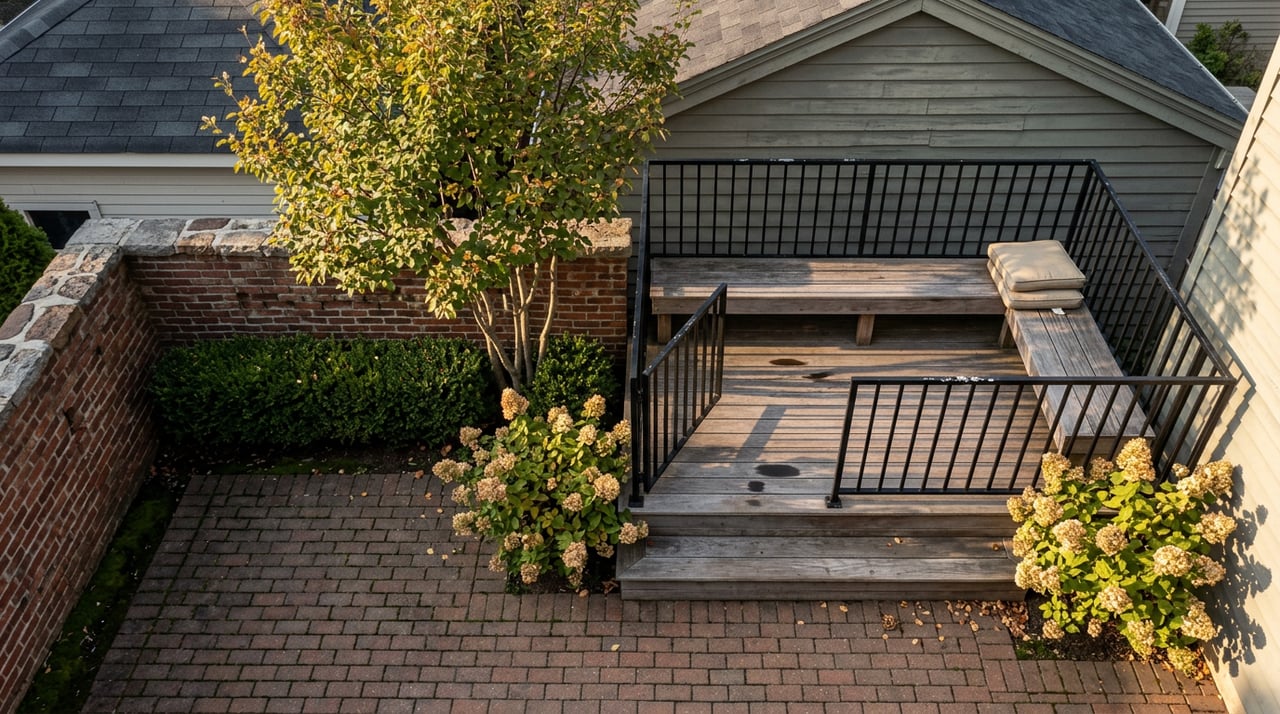
Walk down to the Marginal Street entrance of the Mary Ellen Welch Greenway this week and you'll hit a fence instead of a path. The crossing at Gove Street is barricaded. The stretch that used to carry dog walkers, stroller traffic, and the after-work bike commute between Marginal and Porter Streets has been closed since earlier this year, and the city's own project page doesn't expect it back until the end of the year. For a neighborhood that has spent two decades building its identity around that path, a closure this long should feel like a wound.
It doesn't, and that's the part worth explaining. The trail going quiet this year lines up almost exactly with East Boston getting louder everywhere else: a new ferry route that didn't exist in January, two waterfront restaurants that opened since April, and a park a block from the construction fence that just hosted one of its biggest community days of the summer. The greenway isn't the only thing connecting this neighborhood anymore, and 2026 is the year that became obvious.
What's actually closed, and what isn't
The closure itself is narrower than it sounds. The $3.6 million project, run by Boston Parks and Recreation, is rebuilding the segment between Marginal Street and Porter Street to fix a problem residents have lived with for years: the path sits low enough that it floods after almost any real storm. The fix includes raising sections of the pathway, adding rain gardens and bioswales, and building in stone drainage trenches, work that simply can't happen with pedestrians and cyclists still running through it. The official detour runs along Orleans Street between Marginal Road and Porter Street.
What doesn't close is just as important. The Massport-owned sections of the greenway, along with East Boston Memorial Park, stay open through construction because the city doesn't own either one. Bremen Street Park, a few blocks further along the trail with the YMCA, playgrounds, and ballfields, sits outside the closed segment entirely, which matters more than it sounds like it should once you see what still happens there. The Friends of the Mary Ellen Welch Greenway, the volunteer group that has advocated for this corridor since before it had its current name, has kept posting updates through the construction rather than going quiet, which tells you something about how the group itself sees this project: as a renovation, not a retreat.
The ferries picked up a piece of the job
If you used the greenway mainly to get somewhere, this was the year that got easier, at least during the week. The MBTA launched its new F10 Harbor Loop Ferry on June 29, connecting Lovejoy Wharf near North Station, Central Wharf by the Aquarium, the Seaport's Commonwealth Pier, and Logan Airport. It runs on a fare structure that matches the subway, $2.40 full fare or $1.10 reduced, and it's built for commuters: weekdays only, roughly every thirty minutes during morning and afternoon peak hours. It won't replace a bike ride to Constitution Beach on a Saturday, but for the segment of Eastie residents who use the greenway as a way to shortcut toward the water and then downtown, it's a genuinely new option that wasn't there in the spring.
The route that's been quietly doing this job for longer is the East Boston Ferry itself, running between Lewis Mall Wharf in Jeffries Point and Long Wharf North near the Aquarium. It's a shorter, more direct hop than the Harbor Loop, and the two routes now connect to each other at the Central Wharf area, meaning a Jeffries Point resident who used to walk or bike toward downtown has more ways to make that trip on the water than at any point before this year.
Here's what that actually looks like for someone living here right now:
- Weekday commute to downtown or the Seaport: the East Boston Ferry from Lewis Mall Wharf, or a transfer to the Harbor Loop at Central Wharf, both running on standard MBTA fares
- Weekday trip to Logan: the Harbor Loop stops directly at the Logan Airport Ferry Terminal, no CharlieCard, contactless or cash only
- Weekend recreation that used to run through the closed segment: the Orleans Street detour, or the Massport-owned stretch of the greenway toward Piers Park, since the Harbor Loop doesn't run weekends at all
That last line matters. The people the ferry expansion actually helps are commuters. The people still dealing with the closure directly are the ones who used the greenway for exercise, dog walking, or getting kids to Bremen Street Park on a Saturday. The detour exists for them, but it's a sidewalk on Orleans Street, not the wide, separated path they're used to.
What opened on the water while the trail was torn up
The more interesting shift is where the neighborhood's newest businesses chose to land. La Tavernetta opened April 13 at 45 Lewis Street, right on the Eastie waterfront, close enough to its sibling restaurant Mida that the two can see each other across the water. It's a southern Italian coastal menu built around a patio and a skyline view, and it's the kind of restaurant that only makes sense if you assume people are already headed to the water's edge rather than passing through on a trail.
Pomona Cafe and Wine Bar followed in mid-August, another new spot planting itself in East Boston with a menu that pulls from the Mediterranean and Latin America. Neither business sits directly on the greenway corridor. Both sit on the water. That's not a coincidence so much as a pattern: when a neighborhood's development energy shows up somewhere other than its main path, it's usually because the path was never actually the center of gravity, just the most visible piece of infrastructure.
The clearest proof of that came in late July, when East Boston held the 30th annual Taste of Eastie, a food festival that's been running since long before the current wave of openings. This year's lineup pulled in longtime favorites like Angela's, serving the traditional dishes of Puebla, Mexico, alongside newer names like Koro Ramen and Sushi and the frozen treat company Popsicools. Thirty years in, this isn't a festival propped up by a single trail or a single stretch of waterfront. It's proof the neighborhood's food identity was never dependent on any one corridor to begin with.
The park next to the fence didn't slow down either
Bremen Street Park sits directly against the closed section of the greenway, close enough that construction equipment and barricades are visible from parts of the park. That proximity didn't stop the Friends of the Mary Ellen Welch Greenway from using the park this past Saturday, August 22, to host East Boston Sports Day, a free community event running from 1 to 4 p.m. with activities from the Red Sox and the Celtics' junior programming, plus a National Anthem performance from Todd Angilly, the Bruins' regular anthem singer. The event ran with support from the East Boston YMCA, the East Boston Foundation, Bluebikes, and Cappuccio Construction.
A few blocks away on Bennington Street, a different kind of community effort is running right now. The fifth annual Adopt-A-Pole campaign for overdose awareness kicked off August 20 at Recovery on the Harbor, with volunteers tying 1,200 purple bows to poles and lamp posts across East Boston and into Chelsea through August 31, marking International Overdose Awareness Day. It's a quieter effort than a food festival or a sports day, but it's the same signal: East Boston's civic life keeps running its normal calendar, construction fence or not.
What this actually tells you about living here this year
None of this erases the inconvenience of a months-long construction closure on a path a lot of people built their routines around. If you walked your dog on the Marginal-to-Porter stretch every morning, you're still detouring down Orleans Street until the work wraps, and no ferry route fixes that. But the bigger picture is that East Boston's public life this year didn't contract around the closed segment. It reorganized around the water instead, through new ferry service that expanded exactly when the trail contracted, through restaurants that picked waterfront addresses over trail-adjacent ones, and through a park and a handful of community groups that kept their full calendar running right next to the fence.
By the time the greenway reopens, rebuilt with rain gardens and an elevated path that should handle the next storm better than the old one did, it'll be rejoining a neighborhood that spent a year proving it didn't need to wait for that reopening to keep functioning.
If you're watching East Boston for reasons beyond an evening walk or where to grab dinner, the team at Coldwell Banker First Quality Realty has been tracking this neighborhood's changes for years, both the ones on the water and the ones underneath it. Reach out anytime you want a local read on what's actually happening here.